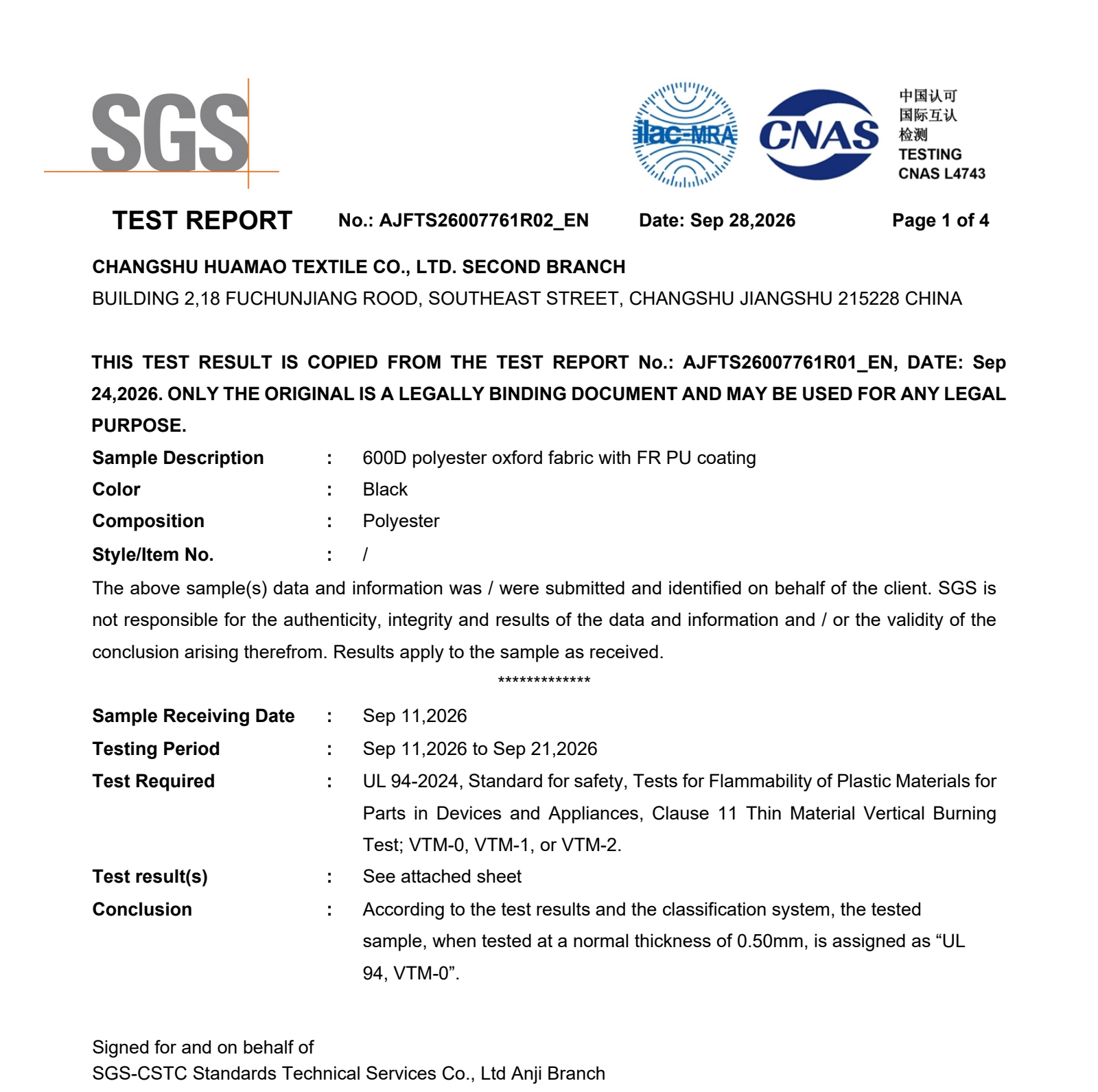
SGS VTM-0: What FR PU-Coated Oxford Fabric Testing Shows
The black FR PU-coated Oxford specimen achieved UL 94 VTM-0 at 0.50 mm. Third-party results let buyers check afterflame behaviour, flaming drops and conditioning, with specific evidence for screening flame-retardant coated materials.
No cotton ignitionNeither group showed ignition from flaming drops
What capability does this test establish for buyers?
A “flame-retardant” description alone is insufficient for material review. This SGS report records thickness, specimen count, two conditioning groups, afterflame and afterglow times, and whether flaming drops ignited a cotton indicator. Buyers can compare defined requirements with measured results instead of relying only on composition or a coating name.
The specimen was assigned VTM-0, a stringent classification within the UL 94 thin-material vertical burning series for afterflame, afterglow and dripping behaviour. It supplies checkable evidence under specified conditions. The project owner still needs to confirm the required classification and suitability for the final equipment.
Measured results: what did each group record?
Afterflame and afterglow: recorded as 0 s
All 10 specimens across both groups recorded t1, t2 and t3 as 0 s. t1 and t2 are afterflame times following the two flame applications; t3 is afterglow after the second application. Times were recorded to the nearest second. These are observations after removal of the test flame, not proof that the material cannot burn during flame exposure.
Propagation and dripping: both recorded as No
Neither group recorded afterflame or afterglow reaching the 125 mm mark, or cotton ignition from flaming particles or drops. These results support checking laboratory requirements for flame cessation and dripping; they do not establish a fire-risk-free complete assembly.
See pages 2–3 of AJFTS26007761R02_EN. Its VTM-0 criteria specify individual t1 and t2 ≤10 s, a five-specimen group total t1+t2 ≤50 s, t2+t3 after the second application ≤30 s, no progression to the mark and no cotton ignition. Page 1 gives the final VTM-0 classification.
Two conditioning groups make the comparison more specific
Standard conditioning: five specimens
At least 48 hours at 23±2°C and 50±10% relative humidity before testing.
Heat conditioning: another five
168±2 hours in a circulating-air oven at 70±2°C, followed by at least four hours of cooling in a desiccator at room temperature.
Results in both states provide more complete material-screening evidence. The 70°C temperature is a test-conditioning parameter, not a certified continuous operating temperature. The report also supplies no results for wash-retained flame performance, long-term ageing, smoke density or toxicity. Define additional verification when the project requires these properties.
How does VTM-0 differ from V-0?
UL explicitly states that VTM-0 and V-0 use different methods and are not equivalent classifications.[1] The supported statement is “UL 94 VTM-0 at a tested thickness of 0.50 mm”; this report cannot be relabelled “UL 94 V-0”.
UL 94 addresses small-scale material burning under controlled conditions. An SGS test report does not replace UL product certification, garment flame-retardant certification, a building-material fire classification or approval of a complete duct system.[2] Requirements for V-0, construction use or a finished system need their own corresponding evidence.
Turn the test evidence into purchasing requirements
Specify the use and required classification
State the equipment or material application, target market, standard edition and classification. Confirm that the buyer accepts VTM-0 rather than substituting a similarly named rating.
Match the order material to the specimen
Check black colour, 600D polyester Oxford, FR PU coating, 324 g/m² and 0.50 mm, together with coating formulation, thickness control and the supplied batch. No item number is listed: the report is not automatic evidence for a current catalogue SKU.
Define additional use conditions
Specify washing, repeated folding, abrasion, chemical contact or continuous high-temperature requirements separately. The heat conditioning in this test cannot replace those checks.
Review originals and agree acceptance
Check the R01 original, the R02 copied-results statement, complete results and sample identity. Then agree the approved sample, order specification, batch acceptance and any additional testing.
For duct construction, pressure and temperature selection, see the flexible duct fabric selection guide. That page covers equipment and processing; this page covers the material burning report.
Black 600D polyester Oxford with FR PU coating; 324 g/m²; specimens 200 mm × 50 mm × 0.50 mm. Sample descriptions are client-provided; results apply to the specimen as received.
Method and testing dates
UL 94-2024 clause 11, Thin Material Vertical Burning; 2026-09-11 to 2026-09-21.
Original and copied-results relationship
R02 states that results are copied from AJFTS26007761R01_EN (2026-09-24), and only the original is legally binding. The available R01 names SHANGHAI SHUN YUAN XING TEXTILE PTY, LTD as applicant. The two references represent the same test results, not two independent tests.
Item number and applicability
Style/Item No. is “/”; no current HM item mapping is established. Check the actual sample, specification, coating and batch before ordering. Other colours or thicknesses are not automatically covered.
Buyer questions
Is VTM-0 the same as V-0?
No. UL states that the methods differ and the classifications are not equivalent. This report assigns VTM-0 at 0.50 mm.
Does zero seconds of afterflame mean it cannot burn?
No. The values are afterflame and afterglow after removal of the test flame, recorded to the nearest second. They do not establish a fireproof or non-burning material.
Does testing after 168 hours at 70°C establish an operating temperature?
No. This is specimen conditioning, not a conclusion about continuous service temperature, complete equipment heat resistance or service life.
Are R01 and R02 two separate tests?
No. R02 copies the R01 results and states that only the original is legally binding. Review versions, entities and sample identity together.
Official references and report evidence
Measured values come from pages 1–3 of SGS AJFTS26007761R02_EN, with the R01 original checked. The official sources below explain classifications and scope, not additional company certification.
Match flame-retardant samples and reports to your project
Share the application, target rating, colour, thickness, use conditions and intended order specification so we can check sample directions and corresponding documents.