OCS: traceable organic content for sourcing decisions
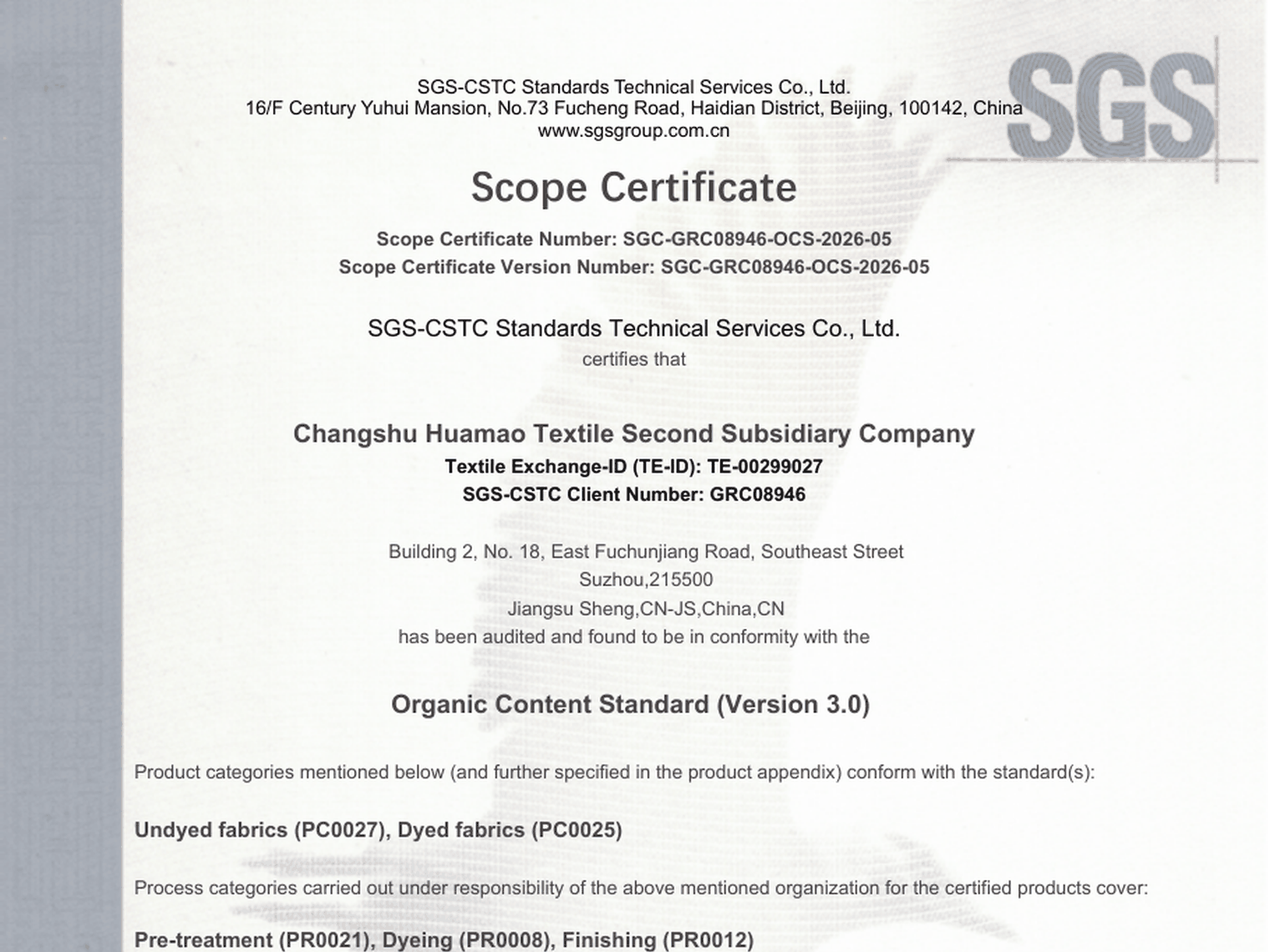
Huamao’s current OCS scope certificate establishes qualification for the listed organic-material pre-treatment, dyeing and finishing. Valid order-level transaction documents support organic-source and content traceability for brand sourcing and claims review.
Updated 2026-10-14Buyer guide
Public document preview · check complete scope before ordering
Why it matters: track organic materials through processing and delivery
OCS sets third-party certification requirements for organic materials and chain of custody. It helps buyers verify organically grown content by connecting material sources, processing stages and transaction records.
For an organic-cotton blended uniform or workwear project, check the current scope certificate’s products and processes, then the order’s content and transaction evidence. Review harmful-substance safety, washing and other performance requirements separately.
Value for sourcing teams
Traceable organic sourcing
Review the organic-material route through source and order documents to support checks of the brand’s content claims.
Listed processing coverage
The current scope includes the specified organic-cotton blended routes for undyed and dyed woven fabrics. Use it to check project processing arrangements.
A document basis for content claims
Match the proposed claim with actual materials, content and transaction evidence before confirming applicable labelling and wording.
A checklist before supplier or order approval
Check scope qualification
Confirm the holder, current status, product appendix and pre-treatment/dyeing/finishing scope.
Check order content
Confirm the selected organic cotton and blends. A certificate entry is not the order’s content percentage.
Check transaction evidence
Match a valid TC or equivalent covering the goods with the order and actual delivery.
Review brand claims
Confirm label grade and wording under current claims rules, and collect separate safety and performance evidence.
Match the document to your project
Basic information & scope
Number / standard
SGC-GRC08946-OCS-2026-05 · OCS V3.0
Holder / issuer
Changshu Huamao Textile Second Subsidiary Company · SGS-CSTC
Validity
Document valid until 2027-06-13; check current status when reviewing an order.
Products and processes
Undyed PC0027 and dyed PC0025 woven fabrics: the listed organic-cotton blends with polyester, spandex and polyamide; pre-treatment, dyeing and finishing.
Delivery evidence
The SC alone does not certify delivered goods; a valid TC or equivalent must cover them.
OCS addresses organic materials; GRS addresses recycled materials. OCS 100 / OCS Blended entries do not mean every catalog product is 100% organic. OCS does not replace product-safety or performance testing.
FAQ
How does OCS help sourcing teams?
It provides a third-party framework for organic materials and chain of custody. Scope certificates and valid order-level transaction documents support checks of organic origin and content claims.
Can OCS and GRS replace each other?
No. OCS addresses organic materials and GRS addresses recycled materials, with different standard requirements. Match the evidence to the order’s sourcing objective.
Does an SC prove the organic content of this delivery?
Not by itself. Check actual order composition, a valid TC or equivalent covering the goods, and the applicable claims and labelling requirements.
Sources and document reference
Standard definitions follow the official sources below. Company qualification and scope follow the actual document; confirm its current status for each order.