Antistatic PASS after five domestic washes: AITEX workwear fabric test results
Huamao’s tested navy workwear fabric recorded a charge-decay PASS after five domestic washes at 60°C. The report also records separate levels for abrasion, tear, breaking strength and puncture resistance. These third-party results give buyers specific evidence for antistatic and durable workwear material selection.
Updated Buyer guide
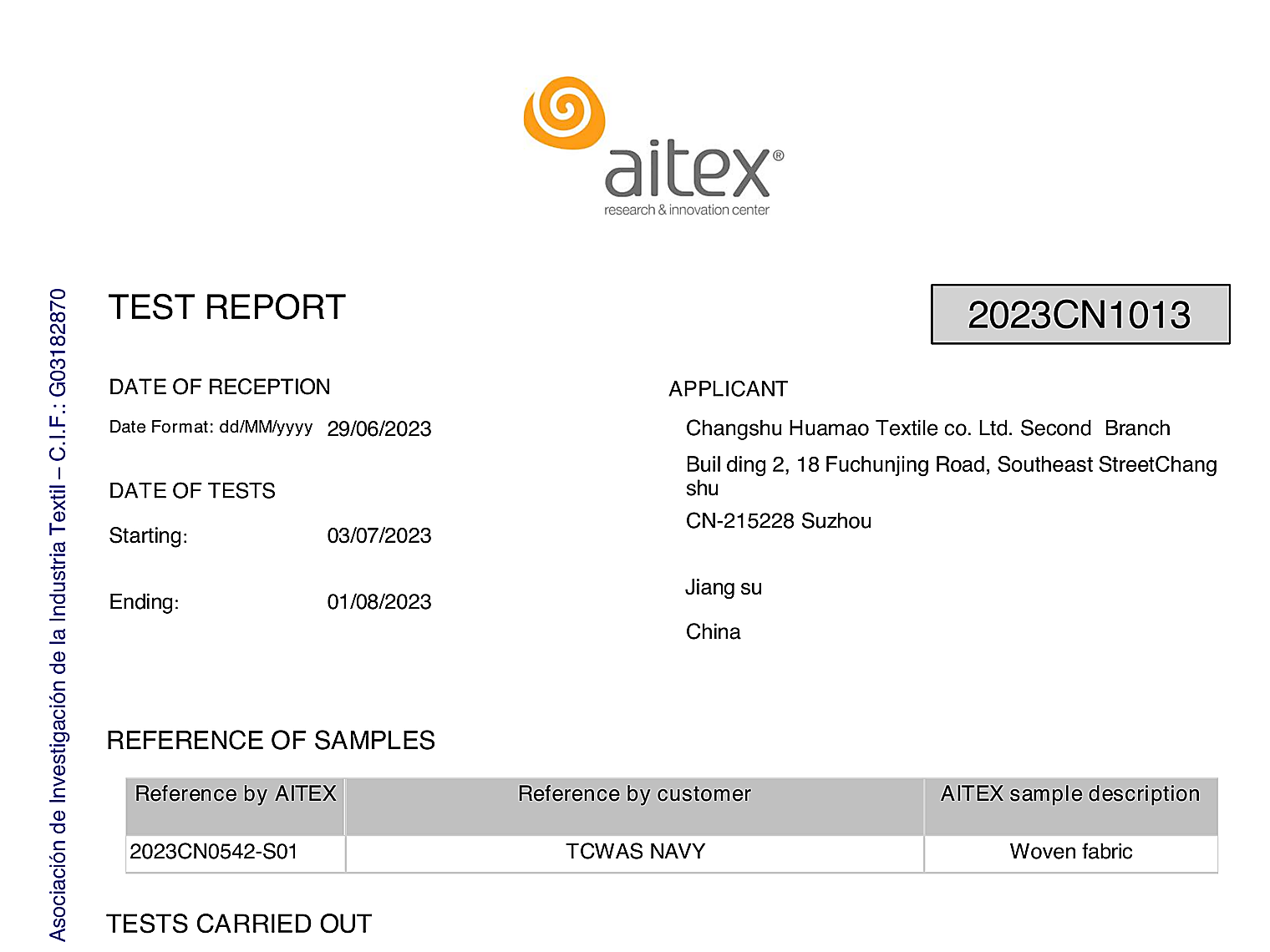
Original report cover preview · TCWAS NAVY test sample
Start with measured performance, then check your sourcing conditions
Charge-decay PASSAfter 5 domestic washes at 60°C
Abrasion level 6Mechanical classification in the report
Breaking strength level 6Tested using the stated method
Third-party measurements give buyers evidence to review
The report breaks antistatic and durability performance into test items buyers can check. It identifies washing pretreatment, methods and results so a sourcing team can compare the tested material with its project requirements.
Charge decay documents how the tested sample dissipated charge under the stated conditions. Mechanical levels add evidence for abrasion, tear, breaking strength and puncture resistance. Post-wash results support material review for repeatedly washed workwear, but five pretreatment cycles do not establish performance after more washes or a service-life guarantee.
What exactly recorded an antistatic PASS?
AITEX tested the washed sample using EN 1149-3:2004 Method 2, the induction charging method. All three specimens recorded a decay half time below 0.01 s and a shielding factor of 0.6. The executive summary records PASS against the stated EN 1149-5:2018 electrostatic requirements. See original report pages 3, 5 and 15.
For buyers, this provides third-party evidence of charge dissipation after the specified washing pretreatment. Finished clothing still needs design, accessory and use-condition review. EN 1149-5 covers electrostatic dissipative protective clothing used within an earthed system; it does not provide protection against mains voltages.[1]
What do the mechanical levels contribute to material selection?
Abrasion · level 6
EN 530:2010 Method 2; 9 kPa; all four specimens recorded N≥2000. The report notes A65 or 240 abrasive paper in place of the specified Nº 00 paper. Retain this deviation when comparing reports.
Tear · level 4
EN ISO 9073-4:1997; reported classification value 76.8 N. This supports material tear-resistance review and does not directly determine garment seam strength.
Breaking strength · level 6
EN ISO 13934-1:2013; mean values of 1700 N in warp and 1200 N in weft. Direction-specific results help buyers compare tensile performance.
Puncture · level 3
EN 863:1995; reported lowest value 74.23 N. This supports material comparison under the stated test conditions, not stab-resistant garment certification.
The levels refer to the methods and classification system on original report pages 3–4 and 7–10. Its abrasion conditions differ from this site’s nylon four-way stretch test using ISO 12947-2 and a wool abradant. Rub counts cannot be directly converted or compared, and do not establish service life.
Read each liquid separately: the summary records TESTED
The report tests four liquids using EN ISO 6530:2005. The summary records TESTED for each; the result pages list penetration, repellency and absorption indices. The observed ranges below cover six specimens across warp and weft. They show differences without adding a blanket PASS conclusion.
Sulphuric acid, 30%
Penetration 0.0–0.1%; repellency 99.3–99.8%. Original report page 11.
Sodium hydroxide, 10%
Penetration 0.0–0.2%; repellency 99.5–99.7%. Original report page 12.
O-xylene
Penetration 2.4–3.3%; repellency 95.7–96.2%. Original report page 13.
1-butanol
Penetration 0.2–0.7%; repellency 98.8–99.3%. Original report page 14.
These are observations under the reported conditions; measurement uncertainties are listed separately in the original. Review the liquid, concentration, contact conditions, washing and project requirements. Do not extend the results to all chemicals or continuous exposure. EN 13034 covers limited liquid-chemical protection and includes garment requirements. This fabric penetration test is not a whole-suit Type 6 spray test.[2]
Connect the results to the sample you intend to buy
Define the workwear use and target standard
State your market, garment use and required material performance. The project owner determines the applicable requirements.
Specify washing and retained performance
This report uses five domestic washes at 60°C. Industrial laundering, additional cycles or other temperatures need a separate validation review.
Check the actual sample, colour and finish
Compare the proposed material with the TCWAS NAVY record. Other colours, formulations, finishes or lots do not automatically inherit its conclusions.
Review the complete report and finished garment
Check methods, pretreatment, deviations, individual results and uncertainties. Responsible parties must separately assess the garment and use system.
Basic information and scope
Basic information and scope
Report / applicant
2023CN1013 · Changshu Huamao Textile Co., Ltd. Second Branch
Test sample
TCWAS NAVY; AITEX reference 2023CN0542-S01; washed subsample 2023CN0542-S01_P1. No mapping to a current HM item code is established.
Customer-supplied composition
65% polyester, 34% cotton and 1% antistatic fibre. This is customer-supplied information, not a composition-test conclusion in this report.
Pretreatment
EN ISO 6330:2021, procedure 6N, five domestic washes at 60°C; drying procedure F (type A1 tumble drying) at 70°C.
Testing and signature dates
Tests from 2023-07-03 to 2023-08-01; signed 2023-12-05. The article update and original testing dates are shown separately.
Document applicability
Historical test evidence for the sample submitted in 2023. Check current samples, specifications, finishes and the buyer’s report-recency requirements before ordering. It is not blanket evidence for the current catalogue or every supplied lot.
Performance statements refer to the washed sample and conditions identified in the report. The complete original is discussed through controlled project review. The public cover and this guide do not replace it, certify a finished garment or approve workplace use.
Buyer questions
Does 1% antistatic fibre alone prove antistatic performance?
Composition is a material description. Review needs the identified sample, test method, pretreatment and measured results. This report’s PASS comes from charge-decay testing after washing.
Does PASS after five domestic washes also prove 50 industrial washes?
No. This AITEX report uses five domestic washes at 60°C. The samples and conditions differ from the SGS industrial-washing report, so the results are not interchangeable.
Can abrasion level 6 be compared directly with 100,000 rubs?
No. The abradant, method, pretreatment and endpoint differ. Check the conditions before comparing suitability for your project.
Do EN 13034-related fabric tests certify a finished garment?
No. Fabric data supports material review. The finished garment also needs review of design, seams, applicable tests and the relevant assessment requirements.
Official references and report evidence
Performance data comes from the original AITEX 2023CN1013 report. The official pages below explain laboratory services and standard scope; they do not establish additional company certification.